
linna.sunshinemachinery@gmail.com    +8617863752766
Cont

Have any Questions?

+8617863752766

Single Column Hydraulic Press

What is Single Column Hydraulic Press


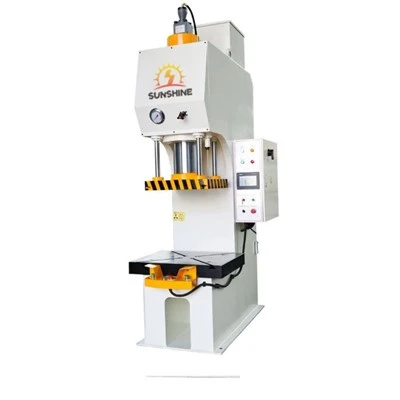
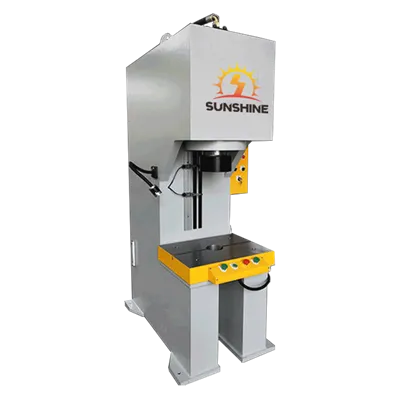
Single Column Hydraulic Press is a hydraulic forming equipment, which is characterized by a single column design in structure. It is widely used in industrial production, such as in the fields of automobile parts manufacturing, home appliance manufacturing, plastic products production, etc., and has its unique application value and effect.

Benefits of Single Column Hydraulic Press


Main features and applications:


Simple structure

The single-column structure makes the hydraulic press more convenient for installation, commissioning and maintenance.


Wide applicability

Suitable for pressing, forming and processing of various materials such as metal, plastic, rubber, etc.


Precise control

The hydraulic system can accurately control pressure, speed and position to ensure the stability of the processing process and the quality of the product.


Multiple operating modes

It can be operated manually, semi-automatically or fully automatically, and different working modes can be selected according to needs.

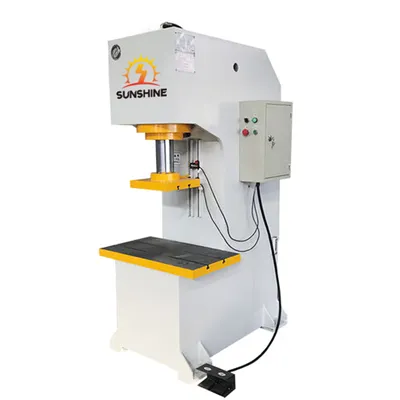
Punching C-type hydraulic press
Add to Inquiry
Punching C-type hydraulic press

Single-column hydraulic press:. Powder forming press/sheet metal drawing press/straightening press/stamping press
Single Column Hydraulic Press
Add to Inquiry
Single Column Hydraulic Press

You’re pressing bearings into truck axle housings in your repair shop, or straightening bent steel plates in your metal fabrication workshop. Your old press is slow, the pressure is inconsistent, and
High strength single column hydraulic press
Add to Inquiry
High strength single column hydraulic press

The single-column hydraulic press has fast pressing speed, high reliability, high reliability and strong adaptability.
Four Pillar Hydraulic Press
Add to Inquiry
Four Pillar Hydraulic Press

What is Single Arm Hydraulic Press Mainly suitable for stretching,forming,pressing and other processes of metal products.It can also be used for the processing of non metallic materials,the
Multifunctional Single Arm Hydraulic Press
Add to Inquiry
Multifunctional Single Arm Hydraulic Press

Our multifunctional single arm hydraulic press is a compact, heavy‑duty machine built for metal forming, straightening, pressing, and assembly jobs. It combines stable pressure, easy operation, and
C-type Single-arm Structure Single-column Hydraulic Press
Add to Inquiry
C-type Single-arm Structure Single-column Hydraulic Press

C-type single-arm structure single-column hydraulic press The single-arm hydraulic press is equipped with a four-column guide to improve product accuracy. The columns and piston rods are quenched and
High Strength Single Arm Hydraulic Press
Add to Inquiry
High Strength Single Arm Hydraulic Press

High strength single arm hydraulic press The single-column hydraulic press has good structural rigidity, good guiding performance, fast processing speed, and the single-column design makes the
Single Arm Hydraulic Press
Add to Inquiry
Single Arm Hydraulic Press

This series of machine tools can be used for shafts and other similar calibration processes, for pressing and assembling of shafts and sleeves, as well as for stretching, forming and blanking of
Single column hydraulic stretch forming press
Add to Inquiry
Single column hydraulic stretch forming press

The Single column hydraulic stretch forming press is a versatile and efficient machine that is easy to operate. This machine utilizes a hydraulic system to generate pressure that can be used to mold
Servo Hydraulic Press
Add to Inquiry
Servo Hydraulic Press

Hydraulic presses are an integral part of most manufacturing industries, offering high precision and accuracy. With the advent of servo hydraulic presses, the industry has seen a significant
 
Why Choose Us
 
01/

Excellent Quality

For each process,we have strict inspection standards,and we always insist that quality is life.

02/

Perfect Service

Perfect after-sales service as an effective value-added service for customers.

03/

Good Cooperation

The company follows the quality principle of "Quality is the life of an enterprise".

04/

Professional Solution

With rich experience and one-to-one service,we can help you choose products and answer technical questions.

05/

Cheap Price

We have a professional purchasing team and costing team,trying to reduce costs and profits,and provide you with a good price.

06/

Quick Transportation

We cooperate with professional sea shipping,air and logistics companies to provide you with the best transportation solution.

Single Column Hydraulic Press Components
9d6b5ed6ccf1ea8357fa5f70f3c528f
productcate-700-700
MG7586
productcate-750-750

The main parts are as follows:


1. Single-column structure
There is only one main column (column) on the frame to support and fix the workbench or piston. This design makes the equipment easier to operate and maintain.


2. Hydraulic pump and control system
The hydraulic oil is pumped from the oil tank to the hydraulic cylinder through the hydraulic pump to control the up and down movement of the piston or workbench.


3. Workbench
Usually a platform for placing and processing workpieces.


4. Piston
Sometimes also called a movable column, it is a component that moves up and down with the workbench.


5. Operation process
The user sets parameters such as pressure and speed through the control panel.
The hydraulic system drives the hydraulic cylinder according to the set parameters to make the workbench or piston move up and down.
During the processing, the hydraulic system applies pressure to press, form or process the workpiece.
After completion, release the pressure of the hydraulic system and remove the processed workpiece.

Application of Single Column Hydraulic Press


1
productcate-1-1

Applications in automotive hydraulics

Air oil coolers can be applied in several ways but are more predominant in hydraulic engine systems,whereby they come in the form of small radiators with which operate during intervals while the engine is in operation.

2
productcate-1-1

Applications in industry

Air oil coolers are also applicable in the industrial sector.Oil has a higher boiling point than water,which makes it suitable in a development setting.Industries require the use of different types of machinery which work around the clock to meet up with production targets,and with the equipment.

3
productcate-1-1

Application in gearboxes

Oil coolers are also used in regulating the temperature of the gearbox in automobiles.The gearbox is an integral part of any engine and applying oil coolers as a means of regulating temperature ensures that there are rarely performance issues.

4
productcate-1-1

Auxiliary applications in agriculture

Oil coolers are also used in heat regulation within agricultural equipment.Oil cooling isn’t limited to automobile and engine application but also works just as good in static machinery.Air oil coolers are applicable through several ways as stated above and with numerous benefits such as its Lubrication properties.

YYJ16
Components of Hydraulic Air Cooler

Hydraulic oil coolers are heat exchangers,which temper various media with air or a cooling medium.In the case of an oil-air cooler,the medium flows through a cooling register.An electrically driven fan generates the cooling air flow in it.In contrast,oil-water coolers have two separate circuits: one for the cooling medium and one for the medium to be cooled.The heat transfer heats the cooling medium and cools down the medium to be cooled accordingly.In addition to the required cooling capacity,a low flow resistance and the required service life are among the most important criteria when selecting hydraulic oil coolers.Hydraulic coolers can be used universally in almost all industries because of their high media resistance and compact design.

YYJ14
How to maintain Hydraulic Air Cooler

Inspection of components

Inspect the entire heat exchanger and motor fan assembly for loosened bolts,loose connections,broken components,rust spots,corrosion,fin coil clogging,or external leakage.

Regular lubrication

Most low horsepower electric motors do not require any additional lubrication.However,larger motors must be lubricated with good quality grease as specified by the manufacturer at least once in every 6-9 months.

Cleaning the fan blades

Cleaning and inspection of the Fan blades is necessary during the regular maintenance schedule.When handling a fan blade care must be given to avoid bending or striking any of the blades.Fan blades being factory balanced will not work properly if damaged or unbalanced.

Remove the coil

Coil fins that become flattened can be framed back into position.This process may require the removal of the coil from the cabinet.Heat exchangers operating in an oily or dusty environment will often need to have the coil cooling fins cleaned.

 
FAQ
 

Q: Why oil coolers?

A: Hydraulic oil cooler loses a lot of its characteristic at high temperatures.Heat not only reduces the viscosity and the durability of the oil but it also increases the wear and tear of the hydraulic components of the system.It is therefore important to cool the oil.

Q: How does an industrial evaporative air cooler work?

A: Water is pumped from a reservoir to wet the cooling pad.After that,a blower or a fan draws warm air from outside and passes it through the damp pad.As the warm air passes through the wet pad,it is cooled through evaporation before being let out into the air.

Q: How much does the industrial evaporative cooler lower the temperature?

A: The temperature of the air coming out of the equipment depends on the temperature and humidity of the air going in.Also,the constant movement of the air that is created by the blower makes the air released feel 4 to 6-degrees cooler than the actual temperature.

Q: Is an installed Industrial evaporative cooler better than an air conditioning unit?

A: When operating a huge industrial plant,traditional air cooling methods can be expensive or ineffective at fighting extremely high temperatures.However,industrial air coolers come with fitted water tanks or hose attachments that affordably allow for recycling.

Q: What are the benefits of using an Air Cooled Oil Cooler?

A: For most medium to large continuous duty machines fitment of adequately sized air cooled oil coolers becomes mandatory for achieving temperature optimized systems that keep oil temperatures within an acceptable range. Doing so is a basic prerequisite for cost efficient operation, as they provide a number of performance,economic,and environmental benefits.

Q: Where should the hydraulic oil cooler be installed in the hydraulic system?

A: The hydraulic oil goes out from the hydraulic oil tank firstly and enters the hydraulic system to work then returns to the oil tank through the oil return pipe.The hydraulic oil cooler is installed on the oil return line to ensure that the overheated hydraulic oil is cooled before entering the oil tank.

Q: Selecting the best cooler

A: The Right Cooler Will Extend the Life of a Hydraulic System Wind Turbines Accumulator and Cooler DivisionThe process to select a cooler is driven by the type of system that needs to be cooled.Parameters to consider include heat load,power source,noise,operating costs,space available,environmental conditions,and more.

Q: Coolers extend the service life

A: Overheated hydraulics can be caused by decomposing fluid,wear,or damaged seals and bearings.Coolers can prevent overheating and extend the service life of your hydraulic system.However,smaller hydraulic systems with lower operating temperatures can often be cooled through natural convection.If natural convection is not enough,it becomes necessary to add a cooler.

Q: Requirements for coolers

A: Coolers are also crucial for systems with temperature requirements such as needing to stabilize the hydraulic fluid’s viscosity by keeping it at a specific temperature,or equipment with a history of hot oil problems that shortened seal life and break down the fluid.Hot fluid is always a concern with large mobile equipment,as well as commercial and industrial processing equipment.Specifying a properly sized cooler saves time,money and maintenance.

Q: Industrial air coolers work in open areas

A: They also don’t recirculate the same air like the air conditioner.This fresh air helps to increase productivity,promote the feeling of well-being and sustains higher and better concentration levels.An air conditioning unit is highly recommended for domestic use,small industrial rooms,and offices.

Q: What is the maximum temperature and pressure rating for the cooler?

A: Most of the coolers are rated for 250F/250psi.Some of the coolers are also rated for 250F/377psi.

Q: Cold press use

A: Cold press machine is mainly used for plywood veneer,multi-layer board pressing wood door veneer and so on.Piston cylinder oil cylinder is adopted to press the workpiece.The lifting table is adopted for parallel displacement under the action of the balance bar to achieve the active table to keep balance with the lower table at any position.

Q: Hydraulic oil cooler

A: Hydraulic Oil Coolers are suitable for heat transfer fluids,lubricating and quenching oils.They are high quality products incorporating the best materials and the latest technical features.The tube bundle is fully floating so that thermal stresses are minimised and can easily be removed should cleaning be necessary.

Q: What are Air Blast Coolers Used for?

A: Air blast coolers are used for process cooling.Ambient air is forced over a heat exchanger to remove unwanted heat from a closed circuit containing process fluids or intermediate coolant.Coolant return temperatures can be as low as 10°C above ambient air.

Q: How does a rotary cooler work?

A: A rotary cooler works by passing ambient or chilled air through a horizontal rotating drum.Material is fed into the opposite end of the drum,so the material and air flow in opposing directions.

Q: What’s the difference between a direct cooler and an indirect cooler?

A: The difference between direct and indirect rotary coolers lies in the cooling medium.While direct coolers use air in direct contact with the material,indirect coolers reduce the material temperature through contact with the drum shell,which is externally cooled using a chilled water bath.

Q: What does the rotary cooler design process look like?

A: Much like rotary dryer design,engineers must balance a number of different variables to properly size and design a rotary cooler. This includes material characteristics such as bulk density,inlet and outlet temperatures,and more.

Q: What materials are rotary coolers constructed from?

A: Depending on the requirements of the material and process,rotary coolers may be constructed from any of the following metals,Carbon steel,Stainless steel,Specialty alloys,Explosion-bonded steel,Abrasion-resistant steel.

Q: What temperatures do rotary coolers typically operate at?

A: Depending on the inlet material temperature and the desired outlet temperature,rotary coolers may operate at temperatures anywhere between 150°F to over 1000°F.

Q: What are the different ways to chill air for use in a rotary cooler?

A: There are a number of ways to chill the air for use in a rotary cooler.This includes ammonia chillers,refrigeration,swamp coolers,and more.

We're professional hydraulic air cooler manufacturers and suppliers in China. If you're going to buy or wholesale cheap hydraulic air cooler, welcome to get quotation from our factory. All customized products are with high quality and competitive price.

Steam Type Cooling Fan Hydraulic Press, Hydraulic Cold Press

(0/10)

clearall